A Transport Network Changing Global Economy and Politics
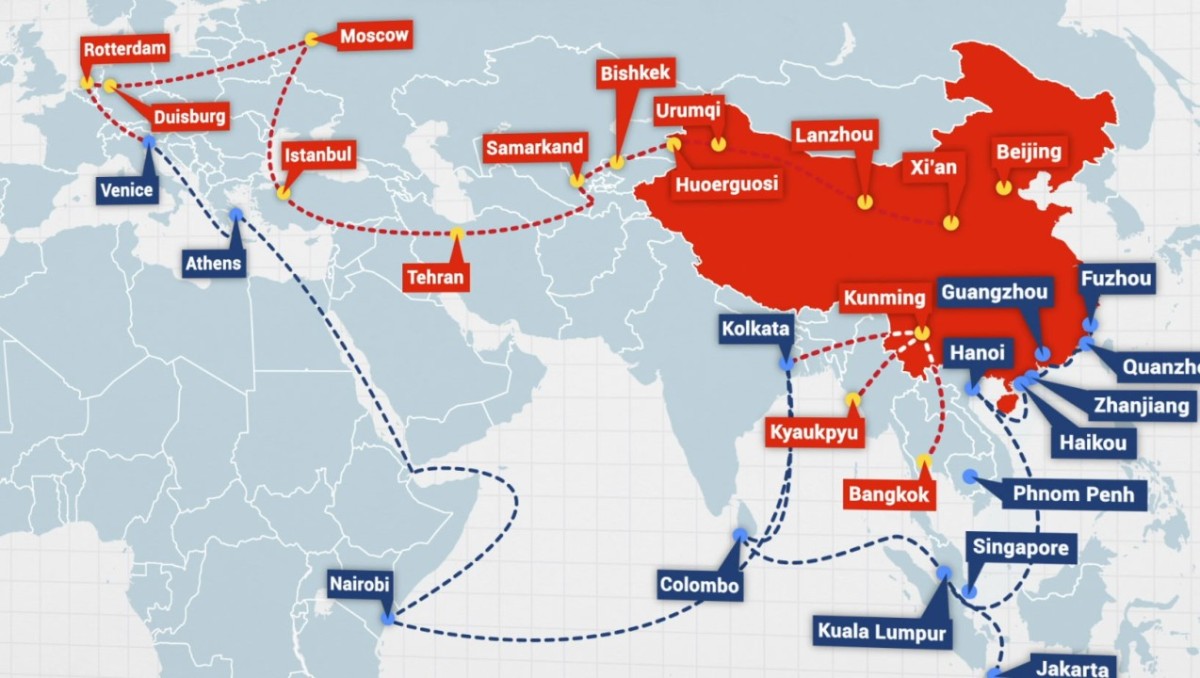
China’s Belt and Road Initiative (BRI) connects more than 68 countries, 65 percent of the world’s population, a third of the world’s GDP, and 25 percent of global trade. Besides, China will loan as much as $8 trillion to 68 countries to improve their infrastructure. The BRI initiative is sometimes called the “New Silk Road,” and most of it is called “One Belt One Road.” China started a large group of development and investment projects in 2013, including one of the most ambitious infrastructure projects ever conceived. This route network, including roads and maritime, connects Asia, Europe, and Africa, ending in China. The Belt and Road Initiative targets creating a large unified market that uses international and domestic markets and facilitates cultural exchange and integration. The most important part is to enhance mutual understanding and trust among member nations, fostering an innovative environment with capital inflows, talent pool, and technology database. The ultimate goal of the BRI is to address the infrastructural gap and accelerate potential economic growth across the Asia-Pacific region, Africa, and Europe. China’s geo-political and economic issues are at the heart of this initiative. China wants to escape the trap of being a “middle-income country” and strengthen its economic and military backbone. China introduced the term “peripheral diplomacy,” which helps to improve relations between China and its neighbors, strengthening economic ties and deepening security cooperation. The US has ended the Trans-Pacific Partnership (TPP) with China because of geo-political and geo-economic issues. The TPP has formed a core part of America’s effort to update and expand trade and investment rules in Asia. Still, the US has yet to draw their attention without their friendly countries in Asia (for example, Japan, India, etc.). It is true that the US has been replaced as the world’s leading economy and is losing its political hegemony to Chinese dominance, and the BRI project is one of the leading factors for China. Washington’s most loyal European allies (London, Berlin, etc.) signed up for the BRI without hesitation and despite strong US opposition. It is very alarming for the US that Chinese products and the economy will dominate the European market. Chinese investments in tourism, real estate, and agriculture, alongside infrastructure projects in Africa, are rapidly increasing, and BRI is becoming a catalyst for African regional economic integration and competitiveness. China is also developing its military hubs in Africa, considering its poor economic conditions. Comparatively low-priced products from Chinese markets are the main reasons for taking Africa into their hands. India is the competitor of China in Asia, and due to BRI Indian security establishment being deeply suspicious, China’s road construction on land frontiers and port-building in the Indian Ocean a “Strategic Encirclement”, and the problem are even more compounded by the presence of the China-Pakistan Economic Corridor (CPEC). BRI has excellent potential for the future of global development. China significantly influences the BRI as an initiator, encourages China’s Go-West policy, and dominates the US market and security. Still, it has a good impact on the economy of its partner. It lays out some significant challenges of the BRI, like its total size and scale, significant infrastructure development, various geography and topography, geographical challenges, and security challenges within the region.
Imagery and data are collected through the internet.